
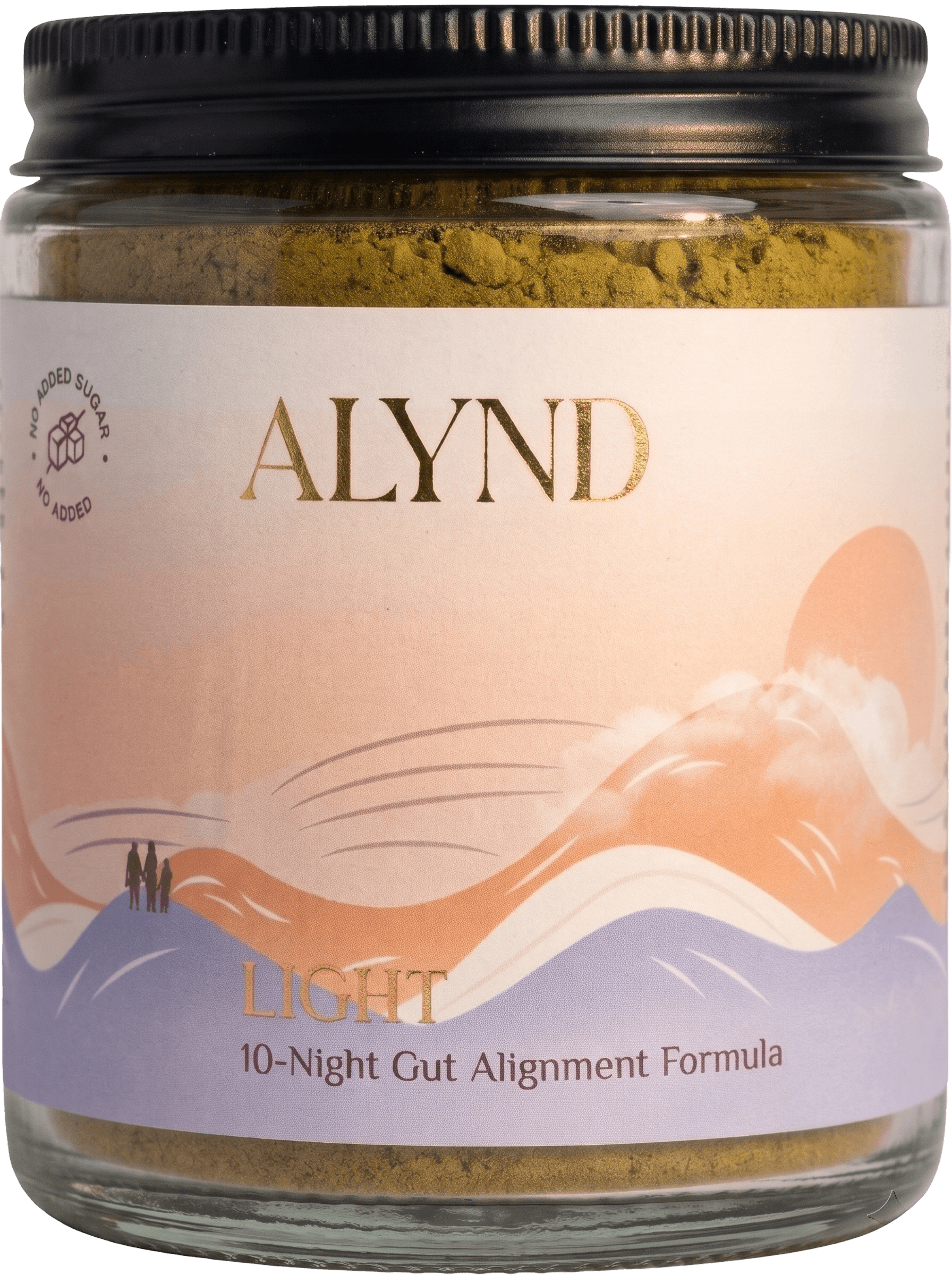
Light
Price
₹699
1 Month

What is ALYND Light?
Your gut called. It wants a little more regularity in its life.
ALYND Light is a 10-day bowel wellness routine made to support regular bowel movements. It's built on a family recipe that's been made the same way for three generations, now with clear amounts and clear directions.
Because feeling backed up isn't the plot twist your day needed.
Your bowel movements shouldn't be a mystery.
- 01
Bowel regularity
Supports a more regular bathroom routine.
- 02
Digestive comfort
Supports comfort when occasional irregularity leaves you feeling heavy or bloated.
- 03
A clear routine
A simple, guided 10-day regimen with nothing to figure out.

Ingredient deep dive
No ingredient gets a free pass just because it's natural.
Every ingredient has to answer four questions: Why this one? Why this form? Why this amount? What evidence supports it?
- 01

- 02

- 03

- 04

- 05

- 06


Left out on purpose
What's not inside matters too.
- Hidden proprietary blend
- [Added sugar]
- [Artificial colours or flavours]
- [Preservatives]
Where our ingredients come from.
[Region or source for each herb, how suppliers are chosen, and what each batch is tested for on arrival. Example: “Our senna comes from [region], where it has been grown for generations.”]
The science
Not all research is equal.
Each study we cite carries one of four labels, strongest first:
- 4/4
Regulatory review
An official body has assessed the evidence for an ingredient
Strongest
- 3/4
Human trial
A study in people, ideally with a placebo group
Strong, depending on size and design
- 2/4
Animal study
Research in animals
Shows a possible mechanism, may not apply to people
- 1/4
Lab study
Research in cells or test tubes
Early clue only
We also label traditional use separately. Centuries of use matter, but they aren't the same as a clinical trial.
Evidence at a glance
Senna
Sennosides A and B
Stimulates colon movement and draws water into stool
Regulatory review for short-term use
Haldi
Curcuminoids
Studied for inflammation signalling and gut comfort
Small human trials
Jeera
Cuminaldehyde
May stimulate digestive enzymes
Small human pilot study
Methi
Galactomannan fibre
Soluble fibre holds water and adds bulk
Fibre physiology is well established
Ajwain
Thymol
May increase digestive secretions
Animal studies
Heeng
Sulphur compounds, ferulic acid
May relax the gut and reduce gas
Lab and animal studies

Formulation
An ingredient list isn't a formulation.
The same herb can do nothing at one amount and too much at another. Here's how we set ours:
- 01
Senna
[Explain how the sennoside amount per serving was chosen, e.g. against regulatory guidance for adults.]
- 02
Supporting herbs
[Explain whether amounts follow the traditional recipe, published studies or both.]
- 03
The 10-day structure
[Explain the reasoning for the step-up and step-down.]
The research behind the gut connection.
The Root Cause page describes how the gut talks to the liver, brain, hormones and skin. These links are an active area of research. Much of it is early, and none of it means ALYND Light treats those systems. We share it so you understand why we start with the gut.

Why 10 days?
days, then done.
A routine with a start and an end.
ALYND Light isn't designed to be taken every day forever. It contains senna, a stimulant ingredient best used for short periods. That's why it comes as one structured routine with a clear finish line, not an open-ended daily habit.
The 10 days are designed to:
- [Reason 1 from your formulation team, e.g. ease in gradually and let you adjust]
- [Reason 2, e.g. support regularity while you rebuild fibre, water and movement habits]
- [Reason 3, e.g. end with a step-down so your routine carries on without the product]
After the 10 days, the goal is for your everyday habits to carry the routine forward. Wait 1 to 2 months before starting another course, and speak to a doctor if you find you need it often.
How to use
Small scoop. Simple routine.
- 123
Day 1–3
Start
- How much:
- 1 tbsp
- When:
- Before bed
- What to expect:
- Your body gets used to the routine
- 4567
Day 4–7
Routine
- How much:
- 1 tbsp
- When:
- Before bed
- What to expect:
- [your team's description]
- 8910
Day 8–10
Finish
- How much:
- 1 tbsp
- When:
- Before bed
- What to expect:
- Finishing the routine so your habits take over
- How to mix
- Stir 1 tablespoon into a glass of warm water. Drink it straight away, before bed.
- Water
- Drink at least [8 glasses] of water through the day while on the routine.
- Food
- Add fibre where you can: fruit, vegetables, whole grains and dal. Keep meal times regular.
- If the effect feels too strong
- If you get loose stools, cramping or urgency, skip a night. Never take more than 1 tablespoon a day. Stop if it continues.
What to expect
Honest expectations.
You may notice
- Changes in how often you go
- A stronger urge to pass stool, often [6 to 12] hours after a serving
- Some gas, mild cramping or temporary digestive changes
- Darker urine while using senna, which is harmless and stops after the routine
Don't expect
- An instant "detox"
- Weight loss
- Permanent results from one 10-day course
- A replacement for medical care
Lasting regularity comes from your everyday habits. ALYND Light is a support, not a shortcut.

Who it's for
Who it's for, and who should check first.
ALYND Light is for adults who:
- Have occasional irregularity
- Want support for bowel regularity
- Feel heavy or bloated when things aren't moving
Don't use ALYND Light if you:
- Are under 18
- Are pregnant or breastfeeding
- Have Crohn's disease, ulcerative colitis, a bowel blockage or appendicitis
- Have stomach pain you can't explain, nausea or vomiting
- Are severely dehydrated
- Are allergic to any ingredient
Ask your doctor first if you:
- Take medicine for your heart, blood pressure, diabetes or blood thinning, or take diuretics or steroids
- Have kidney or liver disease, or gallstones
- Have constipation that is persistent, unexplained or new
- Have used laxatives for a long time
Telling you who shouldn't use a product is part of being honest about it.
Why ALYND
Five reasons to trust the jar.
- 01
Quality
Ingredients chosen with care and sourced from [region / partners].
- 02
Transparency
Every ingredient and amount on the label. No hidden proprietary blend.
- 03
Science
A formula informed by research and centuries of traditional use.
- 04
Simplicity
One structured routine. Nothing to stack.
- 05
Quality control
Every batch tested for [microbes, heavy metals]. [Certifications].
Reviews
Real people. Real routines.
No paid actors. No edited miracles. Just people sharing how ALYND Light fit into their lives.
[★ 4.x]
average from [number] verified reviews
- 5 ★[n]
- 4 ★[n]
- 3 ★[n]
- 2 ★[n]
- 1 ★[n]
How they made it part of their routine.
Be one of the first to share your ALYND Light experience.
Finished your 10 days? Tell us how it went.
Please share your own experience. We can't publish reviews that make medical claims, such as curing a condition.
Our review policy
We publish every genuine review, good or bad, from verified buyers. We never edit what you write. We only remove reviews with offensive language, personal information or medical claims we can't allow under advertising rules.
FAQ
Quick answers.
Why 10 days?
When should I take it?
Can I use it longer than 10 days?
Can I take it with medication?
Why does it taste bitter?

Ready to give your gut a better starting point?
Ten days. Six herbs. One clear routine.
From ₹699
This product is not intended to diagnose, treat, cure or prevent any disease. Read the label before use.
ReferencesWhere our science comes from.
Senna
- European Medicines Agency, Committee on Herbal Medicinal Products. European Union herbal monograph on Senna leaf (Cassia senna L. and Cassia angustifolia Vahl, folium).
Jeera (cumin)
- Agah S, et al. Cumin extract for symptom control in patients with irritable bowel syndrome: a case series. Middle East Journal of Digestive Diseases, 2013.
- Platel K, Srinivasan K. Digestive stimulant action of spices: a myth or reality? Indian Journal of Medical Research, 2004.
Ajwain
- Bairwa R, Sodha RS, Rajawat BS. Trachyspermum ammi. Pharmacognosy Reviews, 2012.
Methi (fenugreek)
- Wani SA, Kumar P. Fenugreek: a review on its nutraceutical properties and utilization in various food products. Journal of the Saudi Society of Agricultural Sciences, 2018.
Heeng (asafoetida)
- Mahendra P, Bisht S. Ferula asafoetida: traditional uses and pharmacological activity. Pharmacognosy Reviews, 2012.
Haldi (turmeric)
- Thamlikitkul V, et al. Randomized double blind study of Curcuma domestica Val. for dyspepsia. Journal of the Medical Association of Thailand, 1989.
- Bundy R, et al. Turmeric extract may improve irritable bowel syndrome symptomology in otherwise healthy adults: a pilot study. Journal of Alternative and Complementary Medicine, 2004.
- Hewlings SJ, Kalman DS. Curcumin: a review of its effects on human health. Foods, 2017.
The gut connection
- Tripathi A, et al. The gut–liver axis and the intersection with the microbiome. Nature Reviews Gastroenterology & Hepatology, 2018.
- Cryan JF, et al. The microbiota–gut–brain axis. Physiological Reviews, 2019.
- Salem I, et al. The gut microbiome as a major regulator of the gut–skin axis. Frontiers in Microbiology, 2018.
- Baker JM, et al. Estrogen–gut microbiome axis: physiological and clinical implications. Maturitas, 2017.
Questions about the science? Write to us at feedback@alyndwellness.com. We'd rather explain than oversell.